
The Critical Role of Battery Monitoring Systems in Data Centers
July 06, 2026
By Daniel Dove, Director of Critical Environments Service
Batteries, Batteries and Batteries—the importance of monitoring them. Have you checked what temperature and humidity conditions your battery manufacturer recommends? Are your batteries stored under those conditions? To make informed decisions, you need accurate data. Unlike car tires, batteries cannot be just visually inspected to determine their condition.
Recommended Range: ASHRAE (American Society of Heating, Refrigerating and Air-Conditioning Engineers) recommends maintaining a temperature range of 18°C to 27°C (64°F to 81°F) for data centers. This range helps prevent overheating and ensures that batteries operate efficiently without degradation.
Executive Summary
Data centers are mission critical environments where uptime is paramount. Batteries within Uninterruptible Power Supply (UPS) systems serve as the last line of defense during power interruptions. However, batteries are also among the most failure-prone components. This paper explores the architecture, compliance requirements, and best practices for implementing Battery Monitoring Systems (BMS) to ensure reliability, safety, and regulatory adherence. This is where Battery Monitoring Systems (BMS) become indispensable.
1. Introduction
- Why it Matters: According to IEEE and NERC studies, over 65% of UPS failures are battery related. Even a single weak cell can compromise runtime and trigger cascading failures.
- Objective: Provide a framework for designing and deploying BMS in data centers, aligned with IEEE Std 1491, IEEE Std 1188, and NERC PRC-005 compliance requirements. [ocs.com], [standards-global.com], [exponentialpower.com]
2. Compliance Landscape
IEEE Standards
- IEEE 1491-2012: Guide for selection and use of battery monitoring equipment in stationary applications.
- IEEE 1188-2005: Recommended practice for maintenance and testing of VRLA batteries.
- IEEE 450-2010: Maintenance and replacement guidelines for vented lead-acid batteries.
- IEEE 2686-2024: Recommended practice for Battery Management Systems in stationary energy storage applications. [standards.ieee.org], [standards-global.com]
NERC Standards
- NERC PRC-005-6: Mandates maintenance programs for protection systems, including battery monitoring and alarming for voltage, electrolyte level, and ground faults.
- Reporting: Systems must generate compliance reports for audits. [eepowersolutions.com], [franklingrid.com]
3. Technical Architecture
A robust BMS integrates hardware and software to monitor:
- Voltage & Current: Detect anomalies in charging/discharging cycles.
- Temperature: Prevent thermal runaway.
- Impedance & Ohmic Values: Predict degradation trends.
- State of Charge (SOC) & State of Health (SOH): Ensure operational readiness.
Diagram: Typical BMS Architecture
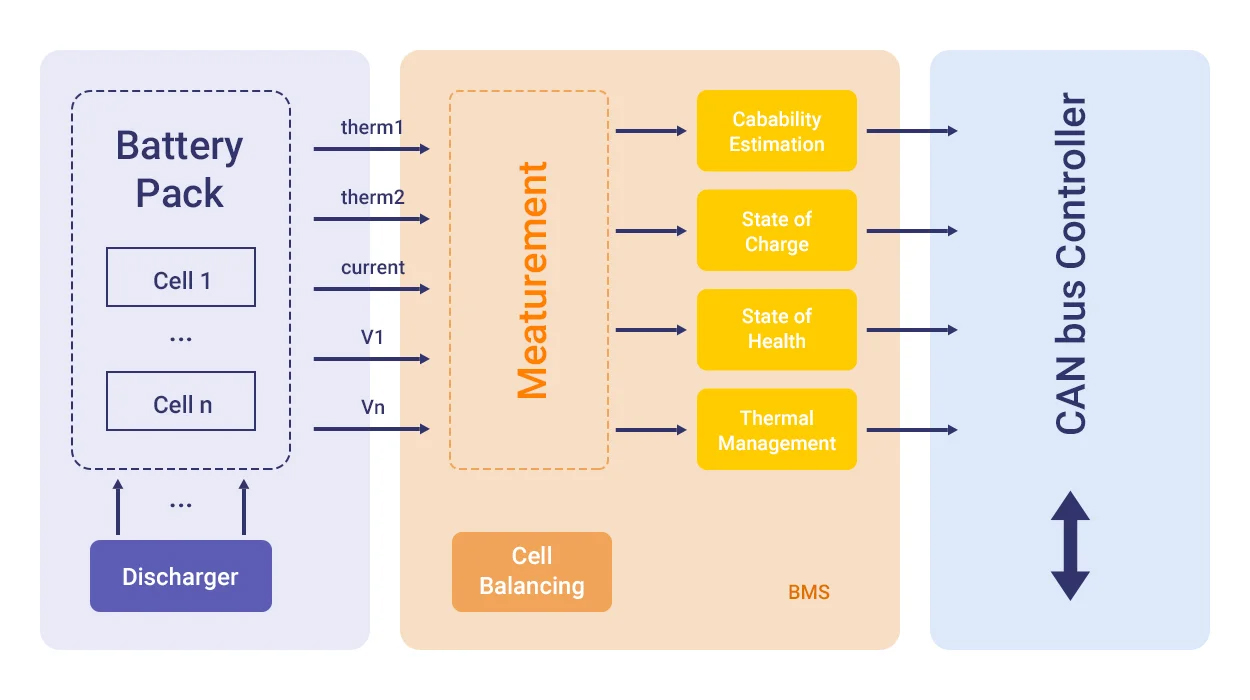 Figure 1: BMS architecture showing cell monitoring, CAN bus communication, and thermal management subsystems. [mokoenergy.com]
4. Integration with Data Center Infrastructure
- DCIM Compatibility: BMS should integrate with Data Center Infrastructure Management platforms for holistic monitoring.
- Remote Access: Cloud-based dashboards for multi-site visibility.
- Alarm Protocols: SMS/email alerts for critical thresholds.
5. Best Practices
- Continuous Monitoring: Real-time data collection for voltage, temperature, and impedance.
- Predictive Analytics: Use trend analysis to schedule proactive maintenance.
- Calibration: Regular sensor calibration to maintain accuracy.
- Compliance Audits: Maintain detailed logs for IEEE and NERC audits. [go.socomec.com], [multitel.com]
6. Benefits
- Improved Uptime: Reduces risk of unexpected outages.
- Cost Savings: Extends battery life by 20–30%.
- Safety: Mitigates fire hazards and thermal events.
- Regulatory Assurance: Simplifies compliance reporting. [baebatteriesusa.com], [exponentialpower.com]
7. Conclusion
Battery Monitoring Systems are critical assets in contemporary data center operations. Adhering to IEEE and NERC standards and implementing advanced monitoring technologies enables operators to uphold reliability, ensure safety, and satisfy compliance requirements. Continuous assessment of battery health and lifecycle facilitates informed, proactive decision-making.
Ensuring these systems deliver long-term value requires proper installation, integration, and ongoing maintenance. Baker Group brings experience in mission critical environments to support BMS systems from implementation through service, helping clients maintain system performance, reduce risk, and ensure operation.
Contact our team to learn how Baker Group can support your battery monitoring system needs.
Dan Dove is the Director of Critical Environments Service at Baker Group with extensive knowledge in Data Center and Mission Critical Projects.